
Offenbach, 02.04.2026
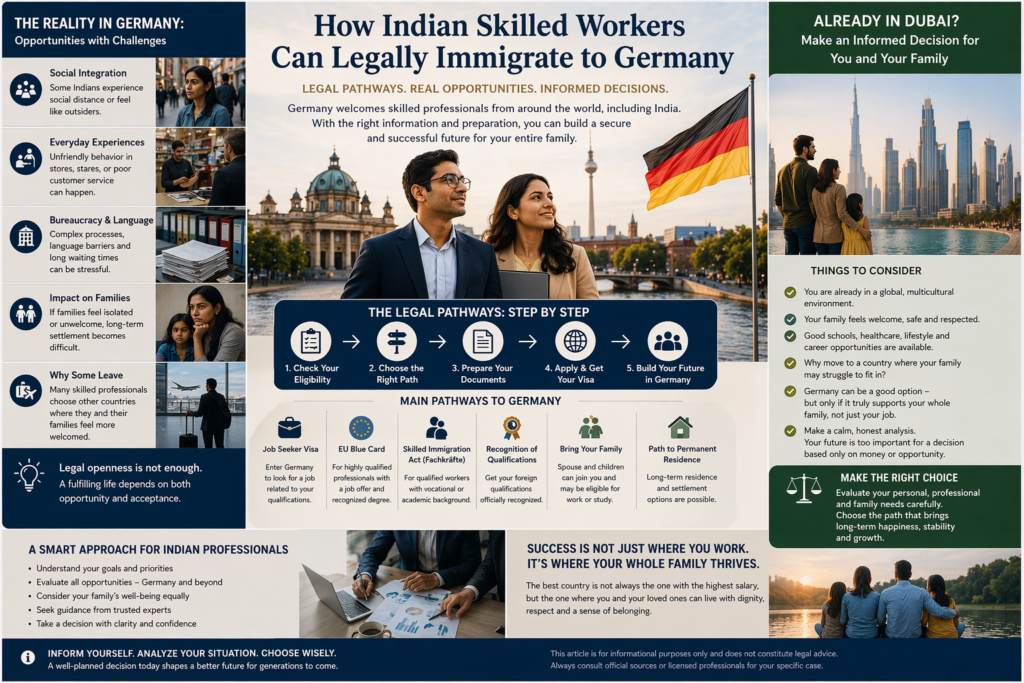
Introduction
When I was in Dubai in February 2026, I met many Indian people who asked me how they could immigrate to Germany. At that time, I was not sufficiently informed about the topic, but I promised them that I would later write something about it here.
There are many different types of visas for Germany, and the appropriate route depends on the person’s profession, qualifications, and overall circumstances. Any application must therefore be made under the visa category that matches the applicant’s specific situation.
There is, however, another very important aspect of immigration to Germany that I explained to everyone who expressed interest in moving there: Germany is an extremely complex society, and this complexity shapes everyday life in profound ways. If you are already well established in Dubai and able to enjoy a good standard of living there, it may be a risky decision to leave that life behind.
In Dubai, opportunities are often more open to people regardless of skin color or cultural background. Although Germany has changed significantly since 2025, much of that change has been driven by legal reforms rather than by a deeper cultural willingness to transform. Laws can change structures, but culture itself cannot be changed by decree.
The transformation Germany needs will take more generations. We are moving in the right direction, but life is short. That is why anyone considering immigration to Germany should examine the decision very carefully and weigh all alternatives with realism and honesty before taking such a step.
Immigrating to Germany
Germany and India have been cooperating more closely on legal migration, skilled immigration, and mobility through the Migration and Mobility Partnership Agreement (MMPA). The agreement was signed in December 2022 and entered into force in March 2023. However, it does not create a single special visa exclusively for Indians. Rather, it mainly facilitates and structures access to the existing German immigration pathways for employment, training, recognition of qualifications, and job search.
For Indian nationals, this means in practice that the route to Germany usually runs through a national visa (D visa) if the stay is intended to last longer than 90 days. The German missions abroad in India refer applicants to the official visa procedures and the legal framework for skilled immigration.
The main pathways for Indian skilled workers
1. Entry with a concrete employment contract as a skilled worker
Anyone who already has a binding job offer from Germany can, in many cases, apply directly for a visa for employment. This applies in particular to people with a university degree or a recognized vocational qualification, provided the qualification matches the job. For persons over the age of 45 who are coming to Germany for work for the first time, additional requirements apply, such as a certain minimum salary or proof of adequate old-age provision.
2. EU Blue Card for university graduates
For many Indian university graduates, the EU Blue Card is the most attractive route. In principle, it requires a relevant university degree, a concrete job offer in Germany for at least six months, and a minimum salary.
3. Immigration based on professional experience
Since the reform of Germany’s skilled immigration law, the country has also become more open to people who do not yet have full German recognition of their qualifications but who can demonstrate a state-recognized foreign qualification and at least two years of qualified professional experience within the last five years. In many cases, this makes entry for employment possible, provided the job in Germany matches the qualification.
4. IT specialists even without a formal academic or vocational qualification
This is especially important for Indian IT professionals: under certain conditions, Germany even allows immigration without a formal university degree or vocational qualification, if relevant IT work experience can be proven. This option exists through the route for professionally experienced workers.
5. Opportunity Card for job search in Germany
Those who do not yet have an employment contract may in some cases initially come to Germany with the Opportunity Card in order to search for work on site. The Opportunity Card is granted either to recognized skilled workers or through a points system. Among other things, applicants must show sufficient financial means. Depending on the route, language skills may also be relevant, for example German at A1 level or English at B2 level within the points system.
6. Visa for the recognition of foreign professional qualifications
If an Indian qualification has not yet been recognized in Germany, or has only been partially recognized, a recognition visa may be useful. It allows the person to come to Germany in order to complete the necessary steps toward full recognition. This is especially important for regulated professions, such as medicine, nursing, pharmacy, or certain teaching-related professions.
7. Recognition partnership with an employer
A particularly interesting newer option is the recognition partnership. Under this model, the skilled worker can already enter Germany and begin working with the support of a German employer while the recognition procedure continues in parallel in Germany. For companies and applicants alike, this is often more practical than waiting abroad for a long time.
8. Entry for vocational training in Germany
Not only fully qualified skilled workers, but also young people from India can come to Germany in order to complete vocational training. There is a separate visa for this. The key requirements are usually an appropriate school qualification, language skills, and a confirmed training placement.
Recognition of qualifications: the decisive factor
A central issue for many applicants from India is the recognition of their qualification. In Germany, the rule is as follows: for regulated professions, recognition is mandatory before the profession can be practiced. For non-regulated professions, recognition is not always legally required, but it can still be very important for the visa, the application process, and salary level.
What does the process look like in practice?
In practice, immigration for Indian skilled workers usually follows this sequence:
First, it must be clarified which immigration route is actually suitable: direct employment, EU Blue Card, Opportunity Card, recognition visa, recognition partnership, or vocational training. Then the question is whether the foreign qualification is recognized or comparable in Germany. After that, the employment contract or other relevant documents are prepared. Only then is the national visa applied for.
What the Germany–India agreement actually does
The German-Indian agreement mainly means that legal and orderly migration is politically desired and institutionally supported. However, it does not replace the German visa requirements. Indian applicants must therefore still choose the appropriate residence title, meet the legal requirements, and provide the necessary documentation. The agreement is therefore more of a framework for cooperation and a facilitator, not an automatic immigration mechanism.
Which applicants from India currently have particularly good prospects
At present, applicants in areas such as IT, engineering, healthcare professions, skilled trades, technical occupations, and vocational training programs with labor shortages generally have especially good prospects. Germany continues to face demand in many shortage occupations, particularly in IT and technical fields.
Conclusion
Indian nationals can now immigrate to Germany through several legal pathways: with an employment contract, through the EU Blue Card, on the basis of professional experience, with the Opportunity Card, for recognition of qualifications, or for vocational training. The skilled migration agreement between Germany and India facilitates this route politically and organizationally, but the decisive factors remain the right visa category, a suitable qualification, and a carefully prepared application.
What Are the First Steps to Make Immigration to Germany a Reality?
Here is a personal step-by-step checklist you can use to turn immigration to Germany into a real plan.
Personal checklist: from idea to visa
1. Define your route
Choose only one starting route first:
- I already have a job offer in Germany.
- I want to apply for the EU Blue Card.
- I do not have a job offer yet, so I need the Opportunity Card.
- My qualification may need recognition first.
- I am in IT and may qualify through the skilled-worker rules even if my path is not the classic one. Germany’s official skilled-immigration portals describe these as the main starting pathways.
2. Check your qualification
Before anything else, verify whether your degree or professional qualification is:
- already recognized in Germany,
- comparable to a German qualification,
- or needs a formal recognition procedure.
For regulated professions, recognition or a licence to practise is essential before you can work. The official recognition portal and Recognition Finder are the right places to start.
https://www.anerkennung-in-deutschland.de/html/en/index.php?utm_source=chatgpt.com
3. Decide whether Germany is right for your whole family
Do not check only salary and visa eligibility. Check:
- spouse’s likely daily life,
- school options for children,
- housing costs,
- language needs,
- how much family support you currently have where you live now,
- whether you are leaving a stable life in another country.
A legal path is not the same as a good life plan.
4. Build your document folder
Create one folder and collect:
- passport,
- CV,
- degree certificates,
- transcripts,
- work references,
- employment contract or job offer if you have one,
- recognition documents if required,
- proof of funds if using a job-search route,
- marriage and birth certificates if family will join later.
5. If you already have a job offer
Then your next questions are:
- Is the job qualified?
- Does the salary fit the route?
- Is your degree recognized or comparable?
- Is your profession regulated?
Germany’s official portal says that for a qualified-professionals work visa you generally need a recognized or comparable qualification and a specific job offer.
6. If you do not yet have a job offer
Then check whether the Opportunity Card fits you. It is meant for people who want to come to Germany to search for employment, and it can be issued for up to one year.
7. Check whether your employer can use the fast-track procedure
If you already have a German employer, ask whether they are willing to support the fast-track procedure for skilled workers. This can speed up coordination between the employer, foreigners authority, recognition bodies, and visa process.
8. Use the official visa portal
Germany’s Federal Foreign Office says national visa applications can now be submitted online through the Consular Services Portal, which has been rolled out worldwide since 1 January 2025.
https://www.auswaertiges-amt.de/en/visa-service/215870-215870?utm_source=chatgpt.com
9. Prepare for the in-person step
Even if the process starts online, you may still need:
- an appointment,
- biometrics,
- originals of your documents,
- possible follow-up requests from the mission handling your case.
10. Prepare for after arrival
Your visa is only the entry step. After arrival, you may need to:
- register your address,
- open a bank account,
- get health insurance in place,
- apply for the residence permit that matches your visa route,
- continue recognition or licensing if required.
The simplest decision tree
A. I have a job offer
Start with:
- recognition/comparability check,
- salary and route check,
- employer document package,
- national visa application.
B. I do not have a job offer
Start with:
- Opportunity Card self-check,
- proof of qualification,
- proof of funds,
- visa application.
C. My profession is regulated
Start with:
- Recognition Finder,
- recognition authority,
- licence/recognition process,
- then visa route.
Your personal “start now” actions for this week
Today
- Choose your route.
- Make one folder with all qualification and identity documents.
Within 3 days
- Check recognition status.
- Check whether your profession is regulated.
- If you have no offer, run the Opportunity Card self-check.
Within 7 days
- Update CV to German-market format.
- Prepare scanned documents.
- If you have an employer, ask whether they support the fast-track procedure.
Within 14 days
- Start the official online visa process through the Foreign Office portal.
https://www.auswaertiges-amt.de/en/visa-service/215870-215870?utm_source=chatgpt.com
My honest advice
Before you move, answer these three questions in writing:
- Why Germany, specifically?
- What happens to my family’s daily quality of life?
- If Germany proves professionally useful but socially difficult, is that still the right decision for us?
- Also, follow immigrants in Germany on social media and learn about the wide range of experiences people have after arriving. Their stories can give you a more realistic picture of everyday life than official visa information alone.
- To understand this issue more deeply, get to know this project and learn more about life as a consumer in Germany: www.de21jh.de.
- At the very end, imagine your life in Germany and your life in Dubai. Be honest with yourself. It is your life.